


South Korea has spent years building high-performance telecom infrastructure. One area now getting more attention is Physical AI for telecom networks.
Physical AI in telecom is not about chatbots or text-based automation. In network engineering, it means using AI systems to observe network behaviour, understand real-world operating conditions, predict outcomes, and trigger actions inside telecom infrastructure. So now let us see What South Korea Is Trying to Solve in Mobile Infrastructure along with RantCell’ LTE RF drive test tools in telecom & Cellular RF drive test equipment and RantCell’s Wireless Survey Software Tools & Wifi site survey software tools in detail.
Partnerships involving GPU computing, AI infrastructure, and telecom systems are being explored to improve how networks are monitored and operated.
A telecom network continuously generates large amounts of operational data. Every radio node, transport segment, subscriber session, and signaling event creates logs, alarms, KPIs, and performance records. Engineers already monitor parameters such as throughput, RSRP, SINR, latency, packet loss, mobility success rate, call setup success rate, handover failures, and congestion conditions. The challenge is not collecting data. The challenge is understanding what action should be taken when thousands of conditions change at the same time.
Traditional network optimization often depends on engineering rules and manual workflows. For example, if throughput falls in one region, engineers may check congestion, spectrum allocation, scheduler efficiency, interference, antenna configuration, or backhaul performance. If handovers fail, mobility thresholds and neighbour relations are reviewed. These methods still work, but they often depend on manual investigation and repeated testing.
Physical AI attempts to reduce the time between network observation and engineering response.
For example, consider a busy railway station in Seoul during peak travel hours. Thousands of users are connected simultaneously. Network demand changes rapidly due to streaming, messaging, mobile payments, navigation apps, and enterprise services. A conventional monitoring system may generate alarms after KPIs cross a threshold. Engineers then review logs, compare counters, and take corrective action.
A Physical AI system would attempt to predict degradation before it becomes visible to subscribers. Instead of reacting after congestion occurs, the system analyses mobility trends, historical load conditions, transport behaviour, radio congestion patterns, and subscriber movement to estimate what may happen over the next few minutes. The system may then recommend changes to traffic steering, carrier utilization, spectrum balancing, or network scheduling.
The telecom industry often talks about automation, but telecom automation has limits. Networks are complicated systems. A small change in mobility parameters may improve one KPI while creating a problem elsewhere.
South Korea’s work in Physical AI is focused more on assisted intelligence rather than complete replacement of telecom engineering teams.
Engineers still define policies, validation rules, and service expectations. AI systems act as operational support tools that help engineering teams make faster decisions using a larger amount of network information.
A second area where Physical AI becomes useful is infrastructure monitoring.
Telecom networks contain thousands of physical assets. Radio units, antennas, transport equipment, power systems, cooling systems, batteries, data center infrastructure, and edge compute hardware all require monitoring.
Traditionally, network operations teams respond to alarms after something begins failing. Temperature increases, equipment instability, fibre degradation, power issues, or abnormal traffic behaviour generate alerts.
Physical AI tries to identify operational abnormalities earlier.
Suppose an edge compute server supporting a virtualized 5G function begins showing small latency variations, rising temperature behaviour, and unusual packet timing conditions. Individually, these signals may not trigger alarms. Together, they may suggest an upcoming service issue. An AI-driven monitoring system can detect these patterns and recommend inspection or workload balancing before subscribers experience degraded service.
South Korea is also paying attention to digital twins in telecom.
A digital twin is a software model of a real telecom environment. Engineers can simulate network behaviour inside a virtual environment before changing settings in production networks.
For example, if an operator wants to modify mobility parameters inside a dense urban network, engineers can first simulate expected behaviour inside the digital twin. They can evaluate handover success, interference behaviour, congestion handling, latency effects, or radio load distribution before applying the change to live sites.
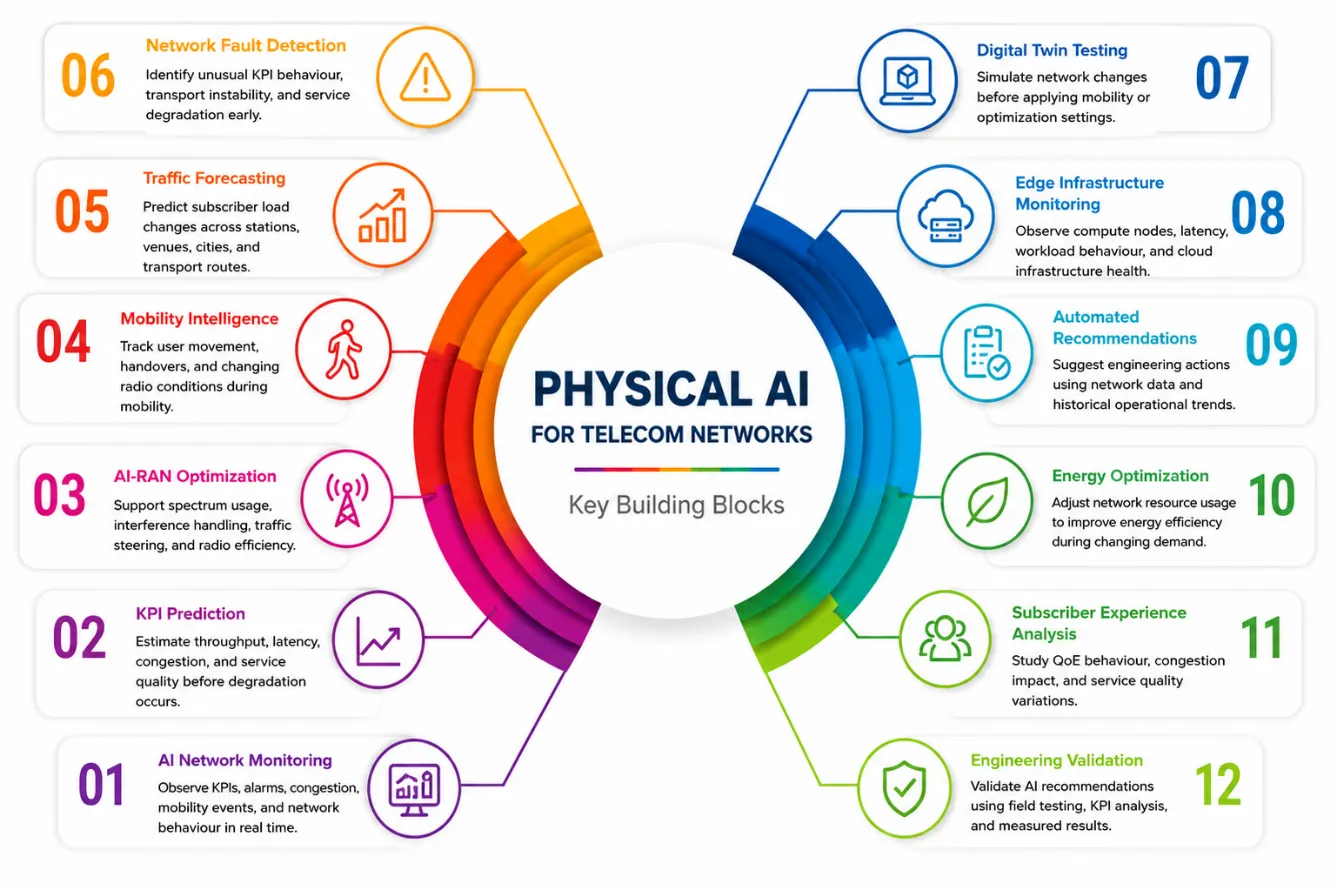
When Physical AI is connected to a digital twin, something useful happens.
Instead of only simulating engineering changes manually, the AI system can continuously evaluate operational conditions and test possible outcomes inside the model. If multiple optimization options exist, the system may rank expected performance impact and suggest safer actions.
This becomes useful in large cities where traffic behaviour changes constantly.
Business districts behave differently from residential areas. Stadiums, airports, shopping centres, railway systems, and industrial zones all generate different mobility and traffic conditions.
South Korea provides a practical testing environment because subscriber density is high and mobile service expectations are strict. Service interruptions or degraded experience become visible quickly.
Physical AI also connects closely with AI-RAN discussions.
AI-RAN refers to applying AI systems to radio access network operations. This includes spectrum efficiency improvements, energy optimization, traffic steering, interference management, and radio resource scheduling.
Radio networks are difficult to optimize because network conditions change every second. A user walking between buildings experiences different signal conditions compared to someone inside a train or shopping centre. Environmental behaviour influences radio quality continuously.
AI systems can process larger amounts of real-time data than traditional manual workflows and identify patterns that engineers may not immediately notice.
This does not mean telecom engineers disappear.
Instead, engineering work changes.
Engineers spend less time manually reviewing repetitive KPI reports and more time validating recommendations, reviewing exceptions, troubleshooting failures, and defining optimization strategy.
| Example Physical AI Use Cases in Telecom Networks | ||||
| Telecom Area | Physical AI Function | Example Use Case | Engineering Benefit | Validation Method |
| Radio Network | AI-RAN optimization | Traffic balancing between sectors | Better throughput | Drive testing |
| Mobility | Handover prediction | Mobility instability detection | Fewer dropped sessions | KPI analysis |
| Core Network | Session anomaly detection | Abnormal signaling behaviour | Faster troubleshooting | Core KPI review |
| Transport Network | Latency monitoring | Transport congestion detection | Stable service delivery | Performance monitoring |
| Edge Computing | Resource monitoring | Compute overload detection | Lower service delay | Cloud analytics |
| Energy Management | Dynamic power optimization | Cell energy adjustment | Reduced operational cost | KPI tracking |
| Subscriber Experience | QoE estimation | Streaming degradation prediction | Better user experience | QoE benchmarking |
| Congestion Control | Traffic forecasting | Peak-hour prediction | Faster response planning | Network analytics |
| Digital Twin | Simulation testing | Parameter validation before rollout | Lower risk changes | Lab simulation |
| Alarm Monitoring | AI-assisted correlation | Multi-alarm pattern detection | Faster RCA | NOC monitoring |
| Predictive Maintenance | Equipment anomaly detection | Site failure prediction | Reduced downtime | Hardware monitoring |
| Field Engineering | Validation support | Compare AI suggestion vs measured data | Better optimization accuracy | Drive test / Indoor Walk Test |
Testing also becomes more important.
Before Physical AI systems are trusted in production networks, operators must validate recommendations carefully. If an AI system suggests mobility threshold changes, carrier prioritization, energy-saving actions, or traffic routing updates, operators need evidence that service quality improves rather than declines.
Field validation remains necessary.
Drive testing, indoor walk testing, benchmarking, QoE analysis, and KPI monitoring continue to play a role because operators still need proof of network performance under real-world conditions.
This is where practical measurement workflows matter. AI may predict subscriber experience, but operators still need measured evidence from field environments to confirm behaviour.
South Korea’s interest in Physical AI shows how telecom operations are changing. Mobile networks are becoming software-heavy systems that depend on cloud infrastructure, distributed computing, and large operational datasets. Manual operations alone are becoming harder to scale.
Physical AI is being explored as a practical engineering tool to help telecom teams monitor networks, predict service problems, test operational outcomes, and improve decision-making speed.
About RantCell
RantCell helps telecom teams test and measure real-world 4G and 5G network performance using Android smartphones and tablets without the complexity of traditional RF testing tools.
Whether it is drive testing, indoor walk testing, benchmarking, QoE monitoring, private LTE/5G validation, or troubleshooting network performance, RantCell helps teams collect field measurements, upload data to the cloud, analyze KPIs, and generate reports from a single platform.
The solution supports dashboard analytics, automated reporting, indoor testing workflows, throughput testing, and advanced engineering workflows such as band locking and Layer 2/Layer 3 analysis on supported devices. Also read similar articles from here.