


For many years, every new generation of wireless technology has followed a familiar path. First comes research inside laboratories. Then prototype systems appear. After that, field testing begins, standards are developed, equipment vendors prepare products, and eventually operators start commercial deployment.
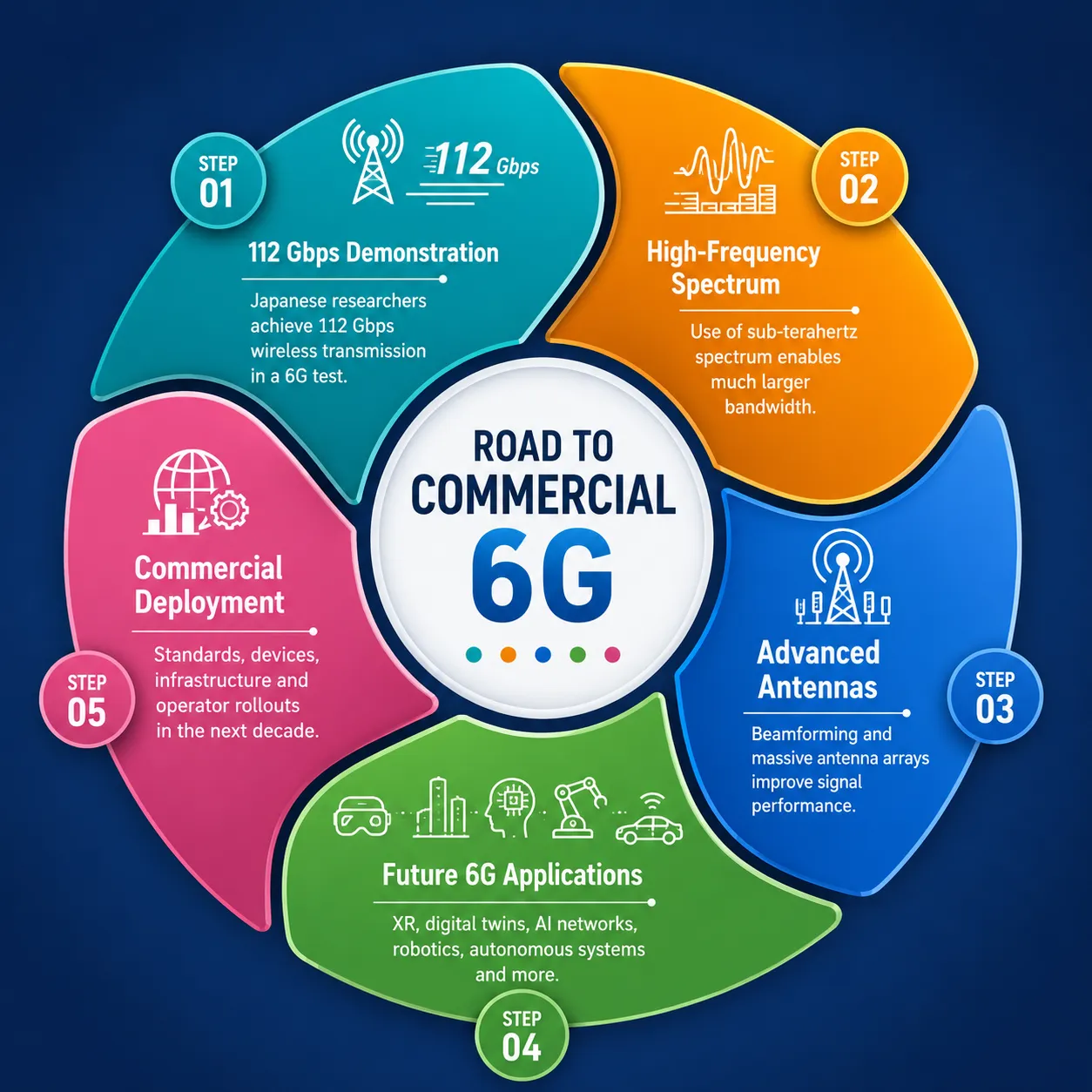
Today, while 5G networks are still expanding across many countries, researchers are already working on the next step. One of the latest developments comes from Japan, where researchers successfully demonstrated wireless transmission speeds reaching 112 Gbps during a 6G-related experiment.
The achievement has attracted attention because it shows how future wireless systems may support applications that require data rates far beyond what current mobile networks can provide. So, now let us look into Japan’s 6G Wireless Transmission Breakthrough (112 Gbps Test) along with RantCell’s LTE RF drive test tools in telecom & RF drive test software in telecom and RantCell’s Indoor cellular coverage walk testing tool in detail.
What Was Demonstrated?
The Japanese research team conducted an experimental wireless transmission trial that achieved a peak throughput of 112 gigabits per second.
To put this into perspective, many commercial 5G users today experience speeds ranging from a few hundred Mbps to several gigabits per second under ideal conditions.
The test relied on very high-frequency spectrum bands, significantly above the frequencies commonly used in current cellular networks. These frequencies provide access to much larger channel bandwidths, allowing researchers to transmit enormous amounts of data within a short period.
The objective was not to create a commercial mobile network overnight. Instead, it was to prove that extremely high-capacity wireless links are technically achievable and can potentially become part of future 6G systems.
Why Does 6G Need Such High Speeds?
A common question is whether anyone actually needs wireless speeds above 100 Gbps.
The answer depends on how communication networks are expected to evolve over the next decade.
Each generation of wireless technology has supported new use cases that previously seemed unrealistic.
2G enabled digital voice communication.
3G introduced mobile internet access.
4G made video streaming practical on smartphones.
5G expanded network capacity and reduced latency, enabling new industrial and enterprise applications.
6G is expected to support services that generate and consume much larger amounts of data than today’s applications.
Examples include:
- Real-time digital twin environments
- Large-scale industrial automation
- High-resolution immersive experiences
- Extended reality (XR) services
- Multi-sensory communication systems
- AI-driven network operations
- Connected robotics
- Autonomous transportation systems
Many of these applications require not only low latency but also extremely high throughput.
This is where transmission rates above 100 Gbps become relevant.
The Role of Higher Frequency Spectrum
One of the major reasons researchers can achieve these speeds is access to higher frequency spectrum.
Current 5G deployments primarily use low-band, mid-band, and millimeter-wave spectrum.
For 6G, researchers are exploring spectrum bands that extend even further into sub-terahertz frequencies.
Higher frequencies offer larger bandwidth resources.
A simple way to think about this is comparing a two-lane road with a twenty-lane highway.
The wider highway can move significantly more traffic at the same time.
Similarly, wider wireless channels allow more data to be transmitted simultaneously.
The challenge is that higher-frequency signals behave differently from lower-frequency signals.
They generally:
- Travel shorter distances
- Experience greater path loss
- Require more precise antenna systems
- Face increased sensitivity to obstacles
- Demand advanced beamforming techniques
Because of these limitations, future 6G networks will need new radio designs and deployment strategies.
Advanced Antenna Technologies Matter
Achieving 112 Gbps is not only about spectrum.
A major contributor is the use of advanced antenna technology.
Future 6G systems are expected to use highly directional beamforming methods.
Instead of broadcasting signals in all directions, networks can focus radio energy toward specific devices.
This improves signal quality and allows more efficient use of available spectrum.
Researchers are also investigating extremely large antenna arrays capable of creating very narrow beams.
These systems can help compensate for some of the propagation challenges associated with higher frequencies.
From an engineering perspective, antenna design will likely become one of the most important areas of 6G development.
What Does This Mean for Mobile Operators?
Commercial mobile operators are closely watching these developments.
Although a 112 Gbps test does not mean subscribers will receive those speeds anytime soon, it provides valuable insight into future network capabilities.
Operators face growing traffic demands every year.
Video consumption continues to rise.
Cloud-based applications are becoming more common.
Industrial connectivity requirements are expanding.
AI workloads are increasing across enterprises.
Future networks will need substantially more capacity than today’s systems.
Research results like this help operators understand what technologies may eventually become available to address those requirements.
Impact on Private Wireless Networks
Private LTE and private 5G networks have become important tools for enterprises operating factories, ports, utilities, airports, and logistics facilities.
As 6G research progresses, private wireless environments could benefit significantly.
Future industrial facilities may include:
- Thousands of connected sensors
- Autonomous mobile robots
- Machine vision systems
- Real-time AI analytics
- Digital twin platforms
- Ultra-high-definition video monitoring
Such environments generate enormous data volumes.
High-capacity wireless links could reduce dependence on extensive wired infrastructure while providing the flexibility that industrial operators need.
This is one reason why many enterprise technology groups are following 6G developments closely.
Testing Will Become More Important
Whenever new wireless technologies emerge, testing becomes a critical part of deployment.
The transition from 4G to 5G already demonstrated this.
Operators needed new approaches for:
- Coverage verification
- Throughput validation
- Mobility testing
- Beamforming analysis
- Latency measurement
- Application performance monitoring
The move toward 6G will likely increase testing complexity further.
Networks operating at higher frequencies require detailed understanding of radio behavior.
Coverage patterns can change rapidly.
Environmental conditions can have a larger impact on performance.
Engineers will need tools capable of collecting accurate field measurements, validating network behavior, and identifying performance bottlenecks.
This will create new opportunities for drive testing, indoor testing, benchmarking, and automated network analytics solutions.
Is Commercial 6G Around the Corner?
Not yet.
The Japanese 112 Gbps demonstration represents a research milestone rather than a commercial deployment announcement.
Several stages still lie ahead:
- Additional laboratory research
- Larger-scale field trials
- International standardization work
- Device ecosystem development
- Infrastructure maturity
- Commercial deployment planning
Most industry forecasts suggest that commercial 6G deployments will begin sometime during the next decade.
Until then, researchers, operators, equipment vendors, and standards organizations will continue refining the technologies that could eventually form the foundation of future wireless networks.
| Topic | Key Takeaway |
| Country | Japan |
| Technology | 6G Wireless Communications |
| Major Achievement | Successful wireless transmission reaching 112 Gbps in a research environment. |
| Purpose of the Test | Demonstrate the feasibility of ultra-high-capacity wireless communications for future 6G networks. |
| Peak Throughput Achieved | 112 Gigabits per Second (Gbps). |
| Spectrum Used | Very high-frequency spectrum bands, including frequencies beyond today’s commercial cellular bands. |
| Why It Matters | Shows that future wireless networks can support data-intensive applications beyond current 5G capabilities. |
| Potential 6G Applications | Digital twins, XR, AI-driven networks, robotics, autonomous transport, industrial automation, and multi-sensory communications. |
| Key Technology Enablers | High-frequency spectrum, advanced beamforming, massive antenna arrays, and next-generation radio architectures. |
| Benefits of Higher Frequencies | Larger channel bandwidths and significantly higher data transmission capacity. |
| Challenges of Higher Frequencies | Shorter range, higher path loss, greater sensitivity to obstacles, and more complex deployment requirements. |
| Role of Beamforming | Focuses radio energy toward users to improve signal quality and spectrum efficiency. |
| Impact on Mobile Operators | Provides insight into future technologies needed to handle growing traffic, AI workloads, and cloud applications. |
| Impact on Private Networks | Supports future industrial environments with thousands of connected devices, robotics, AI analytics, and real-time monitoring. |
| Testing Requirements | Future 6G deployments will require advanced drive testing, indoor testing, benchmarking, and network analytics. |
| Commercial Readiness | Research stage only; not yet ready for commercial deployment. |
| Next Steps for Industry | Further research, field trials, standards development, device ecosystem creation, and infrastructure maturity. |
| Expected Commercial Timeline | Industry forecasts suggest commercial 6G deployment during the next decade. |
| Key Message | Future wireless networks will require significantly higher capacity, intelligence, and testing capabilities than current 5G systems. |
Final Thoughts
Japan’s successful 112 Gbps wireless transmission experiment provides a useful glimpse into what future communication systems may achieve.
The result highlights the possibilities offered by higher-frequency spectrum, advanced antenna technologies, and next-generation radio design.
While commercial deployment remains years away, achievements like this help move the industry forward by validating concepts that were previously confined to theoretical research.
For network engineers, operators, and enterprise connectivity teams, the message is clear: future wireless systems will require more capacity, more intelligence, and more advanced testing approaches than ever before.
The road to 6G is still under construction, but demonstrations such as this show that the technical foundations are steadily taking shape.
About RantCell
RantCell is a mobile network testing, benchmarking, and monitoring platform designed for telecom operators, regulators, system integrators, private network owners, neutral hosts, and enterprises. The platform converts standard Android smartphones into powerful network measurement tools, eliminating the need for expensive traditional drive test hardware. RantCell supports 2G, 3G, 4G, 5G, CBRS, Private LTE, Private 5G, and Wi-Fi network testing.
With RantCell, users can perform RF drive testing, indoor walk testing, network benchmarking, QoE measurements, OTT application testing, Wi-Fi analysis, crowdsourcing, and automated network testing. Measurement data is automatically uploaded to cloud-based dashboards, enabling engineering teams to analyze coverage, signal quality, throughput, latency, voice quality, and user experience KPIs from a central location.
RantCell is trusted by telecom teams worldwide to simplify mobile network testing while reducing operational costs and deployment complexity. Whether testing a nationwide mobile network, a private 5G deployment, an enterprise campus, a railway network, an airport, or a manufacturing facility, RantCell provides a practical and scalable approach to network performance measurement. Also read similar articles from here.